Integrated oven: the decision in brief
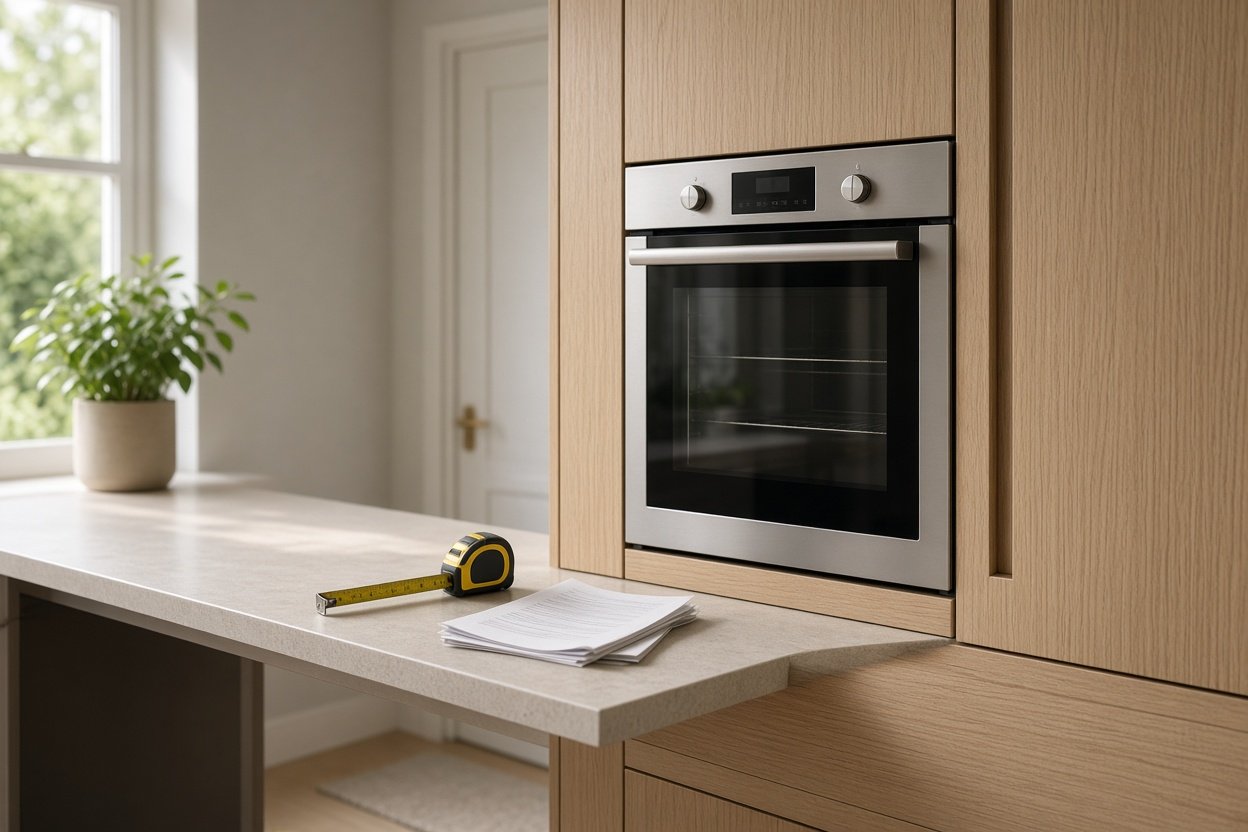
In British retail terminology, “integrated oven” and “built-in oven” commonly describe an oven fitted into kitchen units. A built-in oven is normally sold without a hob, which is bought and installed separately. It can be positioned in a tall housing, including at eye level, while a built-under oven is designed to sit below a worktop or hob.
For most kitchens, the main choice is between a single oven, a full-height double oven, a built-under double oven and a compact oven. Choose the format that matches the available cabinet space first, then compare usable capacity, cooking functions, cleaning features and energy class.
Integrated oven sizes and formats compared
| Format |
Typical size |
What it suits |
| Single built-in oven |
60 × 60 cm |
Everyday cooking in one cavity, usually with a grill |
| Built-under double oven |
60 × 70 cm |
Two ovens below a worktop or hob |
| Full-height built-in double oven |
60 × 90 cm |
Two ovens in a tall housing or at eye level |
| Compact oven |
60 × 45 cm |
Smaller kitchens or an additional cooking appliance |
Integrated ovens are usually around 60 cm wide, but height varies by format. A standard single oven is approximately 60 cm wide and 60 cm high, while a full-height double oven is approximately 60 cm wide and 90 cm high. Guidance differs for built-under double ovens: Which? gives approximately 70 cm in height, while Currys describes the category as approximately 60 cm high. Use these figures as a planning guide and compare the chosen appliance with the cabinet opening and installation diagram.
Oven capacity commonly ranges from 51 to 76 litres. Which? gives an average of 64 litres for a single oven, and around 62 litres for the main cavity and 35 litres for the smaller cavity in a double oven. Usable capacity can be up to 27 litres lower than the stated total because some parts of the cavity cannot be used for cooking.
Sources: Which?’s built-in oven buying guide and Currys’ built-in oven buying guide.
Choosing the best integrated oven format
A single built-in oven is the straightforward choice for everyday meals and most smaller households. Currys describes this format as normally combining one oven and a grill in the same cavity.
A full-height double oven provides two cavities in a tall housing or at eye level. It suits households that cook several dishes at different temperatures, or that want a separate grill and oven space. A built-under double oven also provides two cavities, but is designed for installation beneath the worktop or hob.
A compact oven is approximately 45 cm high. It can suit a smaller kitchen or work as an additional cooking appliance where a full-height oven is not suitable.
Which? uses Best Buy and Eco Buy labels in its testing. Eco Buy identifies models that combine energy efficiency, strong laboratory results and reliable brands. When comparing models, consider the format first, then capacity, dimensions, energy class and the functions that matter for your cooking.
Integrated oven ventilation and installation
For a new kitchen installation, Which? recommends around 5 mm of clearance on each side and 35 mm behind the oven for ventilation. Some cabinets also have 20 mm above the appliance, but this is not presented as a universal requirement. Modern ovens can need more space behind them than older models because of larger fan housings and cooling systems.
Ventilation must therefore be planned as part of the cabinet installation rather than judged only from the oven’s visible front dimensions. The selected model’s installation diagram sets out the relevant arrangement for the appliance and housing.
Electrical installation is also part of safe replacement planning. Most new electric ovens are hardwired, although plug-in models remain available. Which? says that an oven supplied with a standard 13A plug must not have that plug cut off and be hardwired. A hardwired oven should be installed by a qualified professional.
Read Which?’s built-in oven installation guide for installation, ventilation and connection guidance.
Integrated oven and hob packages
An integrated oven and hob package combines the oven with a separately fitted cooking surface. The combinations listed by AO include a single oven with an induction hob, a double oven with an induction hob, a double oven with a ceramic hob and a double oven with a gas hob.
Choose the package by matching the oven format to the available cabinet space and the hob type to the kitchen’s existing arrangement. An oven-and-hob package can simplify product selection, while buying the appliances separately gives more flexibility over oven capacity and hob type. AO lists both electric and gas-hob combinations in this category.
See AO’s hob listings for examples of oven-and-hob combinations.
How to replace an integrated oven
- Identify the existing format. Establish whether the current appliance is a single, full-height double, built-under double or compact oven.
- Choose a like-for-like replacement where possible. A replacement with the same format is normally the least disruptive option. Moving from a single oven to a double oven can require cabinet alterations.
- Allow for ventilation. The housing must provide the clearances and rear space specified for the new appliance. This is particularly important when replacing an older oven with a modern model.
- Plan the installation. A hardwired appliance or a change to the electrical installation should be handled by a qualified professional.
- Consider the cabinet construction. A special-built kitchen can make a change of format more expensive and time-consuming because the housing may need to be modified.
Replacing an oven with one of the same format and corresponding dimensions is usually the simplest route. A change in height or cavity arrangement is more likely to affect the kitchen furniture.
Frequently asked questions
What is the difference between a built-in and an integrated oven?
In UK retail terminology, the terms are often used for the same type of oven: an appliance fitted into kitchen units. The more useful distinction is between a full-height built-in oven, which can go in a tall housing or at eye level, and a built-under oven, which sits below a worktop or hob.
Are integrated ovens a standard size?
They are usually around 60 cm wide, but height varies. Typical formats are approximately 60 cm for a single oven, 70 cm for a built-under double, 90 cm for a full-height double and 45 cm for a compact oven.
What are the best integrated ovens?
The best integrated oven depends on the required format, capacity and installation arrangement. Use the format table to narrow the choice, then compare usable capacity, energy class, cooking functions and cleaning features. Which? Best Buy and Eco Buy labels can provide an additional testing and efficiency reference.
How do I replace an integrated oven?
Start by identifying the existing format and selecting a replacement with corresponding dimensions. A same-format replacement is usually the simplest; changing from a single to a double oven may require cabinet work. Hardwired appliances should be installed by a qualified professional.