How to Choose the Best American Fridge Freezer
- Nyheter
Compare the best American fridge freezers in the UK, including Samsung, LG and Bosch models, prices, sizes, plumbing and energy-use advice.

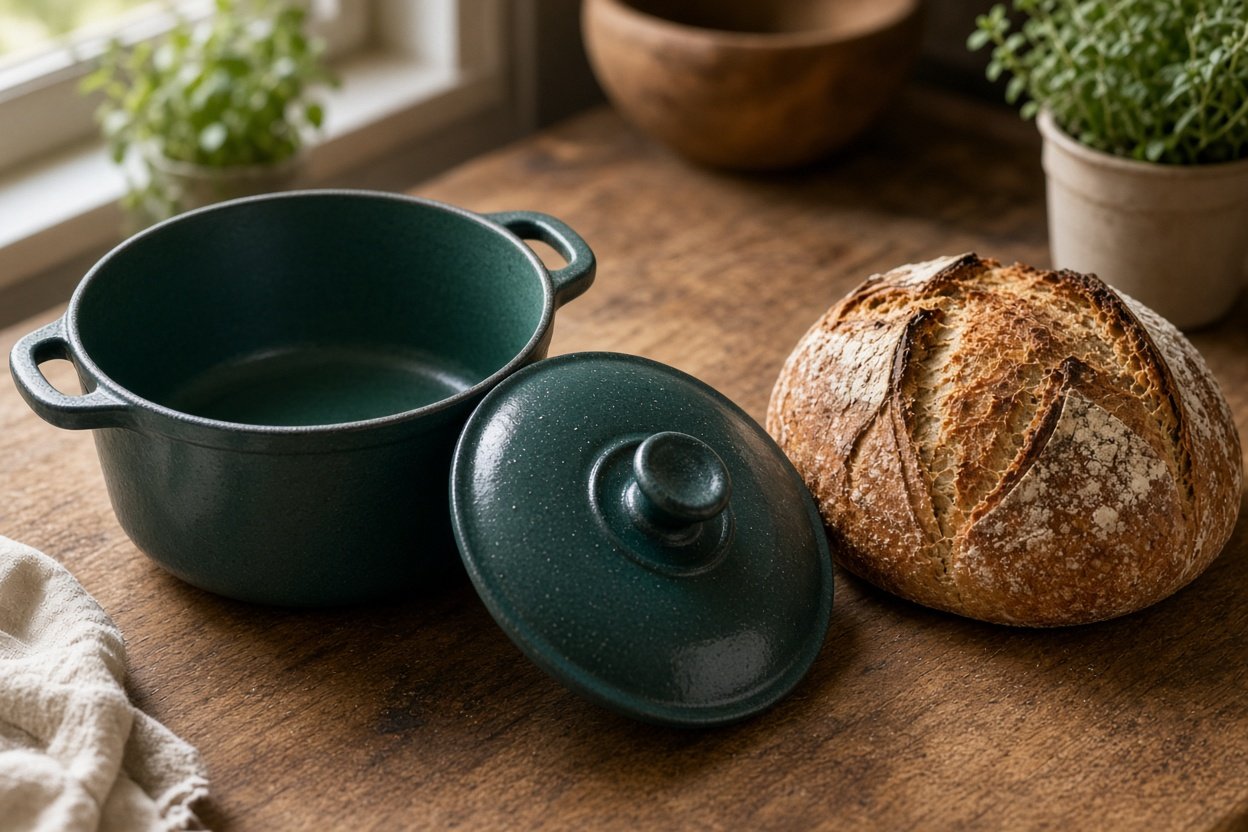

The best Dutch oven for most UK kitchens is an enamelled cast-iron casserole with a capacity of roughly 4.7 to 5 litres. It gives you the heat retention of cast iron, works on common hob types and needs less maintenance than bare iron. Choose a smaller 2.9-litre pot for cooking for two or three people, a 5.6 to 6-litre model for family portions, or a dedicated bread oven if crust and steam are your main priorities.
A Dutch oven is a heavy, deep cooking vessel with a close-fitting lid. It is usually made from iron or clay and can be used on a hob, in an oven or over a fire. The Cambridge Dictionary definition of Dutch oven captures the basic idea; the buying decision depends on material, capacity, shape and care.
In Britain, search for casserole, casserole dish or sometimes cocotte as well as Dutch oven. Le Creuset UK describes its casserole as also being called a Dutch oven, so the terms often refer to the same type of cookware.
These are the strongest choices for clearly defined uses, based on their published materials, capacities, compatibility and prices. They are a practical shortlist rather than a claim that one pot suits every kitchen.
| Product | Best for | Published specification | Price shown |
|---|---|---|---|
| IKEA VARDAGEN enamelled cast-iron casserole | Affordable general-purpose cooking | 5 L; oven-safe; gas, induction and glass-ceramic compatible; 15-year guarantee | £59.00 |
| Nuovva 24 cm enamelled cast-iron Dutch oven | Family portions on a budget | 4.7 L; Nuovva says it suits four to six people | £42.99 |
| Le Creuset Cast Iron Bread Oven | Dedicated home bread baking | Enamelled cast iron; 24 cm; 1.6 L; lifetime guarantee | £265.00 from Le Creuset UK |
| Victoria Round Dutch Oven and Bread Pan | Large round loaves and outdoor cooking | 5.7 L; 7.7 kg; designed for a 1 kg boule; hob, oven, grill, campfire and wood-stove use | Check the retailer listing before purchase |
| Le Creuset enamelled cast-iron casserole | Premium all-round casserole cooking | Suitable for all hobs, including induction, and oven use | Choose a size for your household and budget |
The IKEA price and specification come from its VARDAGEN casserole listing. Nuovva lists the 4.7-litre model at £42.99 and describes it as suitable for four to six people on its 24 cm enamelled cast-iron Dutch oven page. For the Le Creuset bread oven, the manufacturer lists £265.00 including VAT, a 24 cm diameter, 1.6-litre capacity and lifetime guarantee.
The Victoria model is particularly useful when you want a large cast-iron bread pot that can also go over a fire. The specialist retailer describes its round model as suitable for induction, gas, ceramic and electric hobs, ovens, grills, campfires and wood stoves. Its page also gives the 5.7-litre capacity, 7.7 kg weight and 1 kg boule guidance.
A Dutch oven is used for stews, casseroles, braises, roasts, soups and bread. Its thick body retains heat, while the lid holds in moisture; together those properties support slow cooking, roasting and baking.
A heavy pot is not automatically better for every task. It takes more effort to lift and can be slower to heat than lighter spun iron. The advantage is steadier heat once it is hot.
Choose enamelled cast iron for the easiest all-round ownership, bare cast iron for fire cooking and traditional baking, spun iron when lower weight matters, and ceramic when you want a different covered-baker format.
| Material | Main strengths | Trade-offs and care | Best match |
|---|---|---|---|
| Bare cast iron | High thermal mass and heat retention; suitable for slow cooking, roasting and baking | Needs drying after washing and a light coating of oil; do not soak or put it in a dishwasher | Outdoor cooking, bread and traditional casserole work |
| Enamelled cast iron | Retains cast iron’s heat while avoiding seasoning; easier to clean | Heavier than lighter cookware; follow the maker’s hob and temperature instructions | Everyday indoor cooking, especially on induction |
| Spun iron | Lighter than cast iron and heats more quickly | Less heat retention than cast iron | Bread bakers who want lower weight and faster response |
| Ceramic | Available as a covered bread-baking or cooking vessel | Check compatibility and handling instructions for the individual product | Covered baking where a non-metal option is preferred |
Cast iron and spun iron are not interchangeable in use. BakeryBits describes cast iron as heavier with longer heat retention, while spun iron is lighter and heats more quickly. Its range also includes ceramic and copper covered bakers, so material choice can be made around handling as well as heat performance.
Enamelled cast iron is the simplest recommendation for a first Dutch oven. It does not require seasoning, the process of building and maintaining an oil-based protective surface on bare iron, and it is easier to clean than traditionally seasoned cast iron. Bare iron remains attractive for campfire use and bread, but the drying and oiling routine is part of ownership.
Match capacity to the amount of food you normally cook and the space needed around a loaf. There is no single ideal size for every recipe, but the published product ranges give useful starting points.
| Capacity | Good starting point | Verified example |
|---|---|---|
| 2.9 L | Cooking for two or three people; smaller batches | Nuovva’s 22 cm model, which the retailer describes for two to three people |
| 4.7–5 L | General family cooking and everyday casseroles | Nuovva 4.7 L for four to six people; IKEA VARDAGEN 5 L |
| 5.6–5.7 L | Large loaves, generous stews and bigger households | Nuovva 5.6 L bread pot; Victoria 5.7 L round model for a 1 kg boule |
| 6–6.9 L | Large batches and entertaining | Nuovva lists 6 L and 6.9 L enamelled cast-iron models |
For ordinary cooking, start with 4.7 to 5 litres unless storage or serving size clearly points smaller or larger. For bread, consider the loaf’s shape as well as its dough weight. A round pot suits a round boule; an oval pot gives an elongated loaf. The Victoria oval model is 5.7 litres, weighs 7.3 kg and is recommended for an oval loaf of approximately 800 g of dough.
Remember that capacity is only part of the practical size. Measure cupboard shelves, oven clearance and the distance between hob zones. Handles and a heavy lid add to the space needed, and a full cast-iron pot can be difficult to move safely.
For bread, prioritise a lid that encloses the dough well, sufficient room for expansion and a base that suits the loaf’s shape. Steam is the central benefit: the pot traps moisture released by the dough, helping the loaf rise before the crust sets.
A general-purpose cast-iron casserole can bake bread effectively, especially if its lid fits closely. A dedicated bread oven is shaped around that job. The Le Creuset Cast Iron Bread Oven has a domed lid designed to trap and circulate steam, while its low-profile base is intended to promote even browning and a crisp crust. It is made from enamelled cast iron, manufactured in France and covered by a lifetime guarantee.
The choice comes down to frequency and flexibility. Buy a dedicated bread oven if you bake regularly and value its specialised shape. Buy a 5-litre or larger casserole if you want one vessel for bread, stews, braises and roasting. For fire cooking and a large round loaf, the Victoria model’s published campfire compatibility and 1 kg boule guidance are useful differentiators.
Le Creuset’s buying guidance recommends selecting casserole size and shape according to the food you cook and the number of people you feed. That is a better starting point than choosing a famous brand first and trying to adapt every recipe to the pot.
Start with recipes that benefit from steady heat and a covered environment: a slow-cooked stew, a braise, a casserole, a roast or a crusty loaf. The lid is useful whenever moisture retention matters. For bread, use a vessel large enough for the dough to expand without touching the lid.
Care depends on the surface. Wash enamelled cast iron according to the manufacturer’s instructions and avoid treating it like a disposable non-stick pan. Bare, naturally seasoned cast iron needs to be dried after washing and given a light coating of oil. Do not soak it or put it in a dishwasher, because prolonged water exposure can damage the seasoning.
Before buying, read the exact instructions for the model. “Cast iron” does not by itself tell you whether a product is enamelled, dishwasher-safe, fire-safe or suitable for a particular maximum temperature.
As slang, “to Dutch oven” someone means farting under the bedclothes while another person is underneath them. The phrase has a separate meaning from the cooking vessel; Urban Dictionary records the slang definition.
It is commonly sold as a casserole or casserole dish. Some retailers and manufacturers also use cocotte. A UK shopper may therefore find the same broad type of cookware under several names.
Its thick construction retains heat and its close-fitting lid retains moisture. That combination makes it useful for searing, braising, stewing, roasting and baking bread.
Use one for stews, casseroles, braises, roasts, soups and bread. Bare cast-iron versions can also be used over a fire, while enamelled versions are generally intended for hob and oven cooking.